
1-A Major Experiment of Botany

Aim To study the reproductive part in flower of Pea.
Principle: The male reproductive part of a flower are the starmens collectively called androecium and the female reproductive parts are the pistil collectively called gynoecium. The individual units of stamen consists of a filament which bear the anther lobes. Gynoecium consists of stigma, style and ovary. There are various differences found in both of stamens and carpels of different flowers.
Required material- Pea flowers, needles, foreceps, razor, brush, slide coverslips, watch glass, magnifying glass, disecting microscope, compound microscope.
Procedure
1. Observe the flower with naked eye, hand lens, or under a disecting microscope. Study their reproductive parts and count the number of stamen and record their cohesive and adhesive features carefully.
2. After that cut L.S. of lower and place it on a slide and observe its various characters like placement of anthers, position of ovary etc.
3. Now mount-one stamen ona slide and observe its characters like, attachment of filamnents to anther, dehiscence of anther lobes.
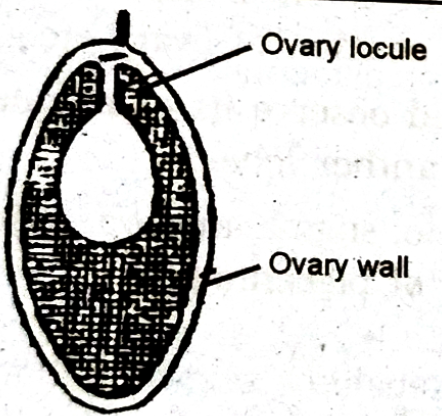
4. Mount the pistil on side and study style, stigma and ovary. Cut the TS. of ovary observe numbers of locules, type of placentation.
Observation
Inflorescence Raceme, Solitary axillary.
Flower-Pedicellate, complete, zygomorphic, bracteate, bisexual, perigynous, pentamerous, white / blue, papilionaceous.
Calyx -Sepals 5 or 4, gamosepalous, campanulate, hairy, valvate aestivation, persistent, green..
Corolla-Petals 5, polypetalous, vexillary (or descending imbricate) aestivation, papilionaceous petals consisting of large posterior petals, the vexillum, two lateral wings (alae) and two inner petals fused to form keel (carina),.
Androecium-Stamens 10, diadelphous 1+(9), 9 fused in the form of tube around the ovary and 1 free. Anther dithecous, basifixed and introrse, dehiscence longitudinal.
Gynoecium Monocarpellary unilocular, ovary inferior, marginal placentation, style small and curved, stigma hairy.
Fruit-Pod or Legume
Seed-Non-endospermic
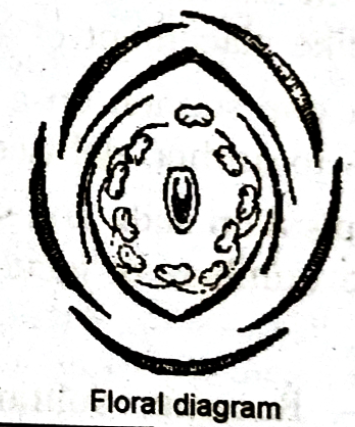
Floral formula – Br %  K(5) C1 +2+ (2) A 1+ (9) G 1
Characters to identify Family-
(i) Diadelphous stamen, (ii) perigynous flower, (iii) papillionaceous flower, (iv)marginal placentation, (v) gynoecium monocarpellary, (vi) corolla vaxillary (or descending imbricate), (vii) ovary inferior.
Classification
Kingdom – Plantae
Subkingdom – Phanerogamia
Division – Angiospermae
Class – Dicotyledonae
Subclass – Polypetalae
Series – Calyciflorae
Order – Rosales
Family – Fabaceae
Sub-family – Papilionatae
Leave a Reply