
(i) Which of the following units of concentration does not depend on temperature?

(a) molarity
(b) Molality
(c) formality
(d) normality
(ii) The reciprocal of resistance is-
(a) resistance
(b) conductivity
(c) cell constant
(d) conductivity
(iii) At the equilibrium state of any cell reaction, the electromotive force (EMF) of the cell is-
(a) positive (b) zero
(c) Negative (d) None of the above
(iv) The unit of rate constant of first order reaction will be
(a) mol L-1s-1
(b) L+1mol L-1s-1
(c) S-1
(d) mol2L-2s-1
(v) Which of the following complexes is an outer orbital and exhibits paramagnetic behaviour?
(a) [Ni(NH3)6]2+
(b) [Zn(NH3)6] 2+
(c) [Cr(NH3)6] 3+
(d) [Co(NH3)6] 3+
(vi) The coordination numbers of Co in the complex [Co(en)2(NH3)2] Br3 are-
(a) 3
(b) 4
(c) 7
(d) 6
(vii) Which ligand is present in the complex? There will be binding isomerism.
(a) NH3
(b) en
(c) NCS–
(d) H2O
(viii) What happens to the atomic size of Lanthanides&as atomic number increases
(a) Radius remains unchanged
(b) First the radius increases then decreases
(c) Radius increase
(d) Radius decrease
(vi) The Co-ordination number of [EDTA]-4 is
(a) 3
(b) 6
(c) 4
(d) 5
(viii) Which element is found in chlorophyll-
(a) Cobalt
(b) Magnesium
(c) Iron
(d) Nickel
(viii) The disease caused by deficiency of Vitamin C is-
(a) night blindness
(b) Beri-Beri
(c) Scurvy
(d) Rickets
(ix) Which of the following compounds is found in abundance in nature?
(a) Fructose (c) Glucose
(B) Starch (D) Cellulose
(x) Which of the following is an essential amino acid?
(a) Glycine (b) Alanine (c) Valine (d) Glutamine
(x) The transformation of primary aromatic amine into diazonium is called-
(a) Diazoation
(b) Nitrification
(c) Aromatization
(d) halogenation
(xi) Benzene reacts with diazonium chloride to give phenol. It is in the following-
(a) H2O
(b) ROH
(c) NH3
(d) None of these
(xii) Dargen reaction occurs in the presence of the following reagent
(a) dry ether
(b) dry acetone
(c) C5H5N
(d) CCl4
(xii) Example of Haloarene is-
(a) CH3CI
(b) C6H5Cl
(c) C6H6Cl6
(d) C6H5CH2Cl
(xiii) How is the rotation of polarized light measured?
(a) Stangometer
(b) mono meter
(c) Polarometer
(d) Viscometer
(xiiv) Which of the following compounds reduces Tollen’s reagent?
(a) CH3COOH
(b) CH3COCH3
(c) HCOOH
(da) C6H5COOH
(xiiv) Alcohols having molecular formula C3H8O can be
(a) only primary
(b) only secondary
(c) Primary and secondary
(d) Primary, secondary and tertiary
¼ⅰ½ The process of exchange of gases in respiration is based on the law of………….
¼ⅰi½……………………. chemical reaction takes place at the anode of a cell.
¼ⅱi½ The reciprocal of resistivity is……………………..
¼iv½ The elements of the ………………………… block are called internal transition elements.
¼v½ EDTA There is a ……………..ligand.
¼ⅵ½ The disease caused by deficiency of Vitamin A is…………..
¼vii½ The formula of cresol is.
¼viii½ CH3-CH2-Br —————– Is the main product of.
¼ix½ The formula of phosgene is……………………
¼x½ The catalyst in Friedel Croft reaction is…………………….
(ii) How many coulombs of charge are there in one Faraday?
(iii) Write the formula to determine conductivity.
(iv) Ti+4 ion is colourless. Give reason.
(v) Write the name of the ligand required to determine the hardness of water.
(vi) Write the names of any two amphoteric ligands.
(vii) Write the names of two essential and non-essential amino acids each.
(viii) Arrange the following in decreasing order of basicity: C6H5NH2, C6H5N(CH3)2] , (C6H5)2NH and CH3NH2
Section B
4 Calculate the mass of Vitamin B (ascorbic acid C6H8O6) which, when dissolved in 75 gm acetic acid, reduces its freezing point by 1.5°C. [kg=39 Kkg mol-1]
5. Write the difference between osmosis and diffusion.
6. Define the order and molecular number of reaction with examples.
7. (i) Why do transition elements form strong metallic bonds?
(ii). Why are transition elements used as strong catalysts?
vFkok
(i) Why are Zn, Hg and Cd not considered transition elements?
(ii) Why is Zn2+ ion colourless?
(iii) Why do transition elements form interstitial compounds?
8. What is the shape of chromate ion? Make its structure.
9. Explain the oxidation state, hybridization, geometry and magnetic nature of the [Co(NH3)6]3+ complex according to the VBT theory.
10. Write difference between ∝- Glucose and β- Glucose. Describe the pyranose structure of Glucose.
11. What is Tollen’s reagent? Give the chemical equation for which group it is used to test.
12- Complete the following reactions.
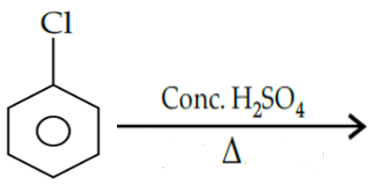

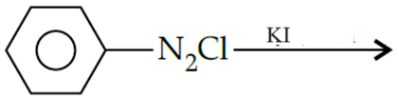
13- Explain the chemical reaction of making chive powder from cumine.
14- An organic compound having molecular formula C3H6O gives orange-red precipitate with 2,4 dinitrophenylhydrazine but does not reduce Tollen’s reagent. Give the name and structural formula of the compound.
15- Write the following transformations.
Primary Alcohol to Aldehyde
Butane-2-on to Butane-2-ol
Salicylaldehyde from Phenol
Section-C
16. (i) Explain the ammonical decomposition of alkyl halide by giving chemical equations.
ii) Complete the following chemical reaction. Identify A and B.
C6H5NO2 [A] [B]
Why is ethinyl slightly soluble in water but completely soluble in water?
Or
Anilene is a weaker base than methyl amine. Explain the reason.
In the following chemical reaction. Identify and write the chemical equation.
2CH3-CHO A B
Write the resonance structure of chlorobenzene.
17 Establish the integral velocity expression formula for the first order reaction.
¼2½ Explain pseudo first order reaction.
¼3½ Write the velocity expression of the reaction C12H22O11 + H2O C6H12O6 + C6H12O6
¼1½ Write the definition of order of reaction
¼2½ Give an example of first order reaction
¼3½ Explain the effect of concentration of reactant on the rate constant.
18- The boiling point of alcohol is higher than that of hydrocarbons of equivalent molecular mass? explain
What happens when ethanol is reacted with thionyl chloride? Write the equation.
Write the IUPAC name of ethylene glycol.
Compare the acidity of phenol and alcohol.
Calorie Write the chemical equation for making phenol from benzene.
Why does the solubility of alcohol in water decrease as the molecular weight of alcohol increases?
19- Spreading test is used to identify which group? Give chemical equation.
¼2½ Write the difference between Rosemund reaction and Stefan reaction.
¼3½ Write the chemical equation of Cannizzaro reaction.
¼4½ Draw the orbital diagram of alcohol.
Write the equation for converting ethane nitrile into ethanoic acid.
Why does benzoic acid not exhibit Friedel-Crafts reaction?
Differentiate between aldehyde and ketone using Tollen reagent.
Explain the acidic nature of ∝- carbon in carbonyl compounds.
¼20½ Write Faraday’s second law. Make further diagrams and obtain the expression of the Nerst equation.
¼2½ Write the expression to find equivalent conductivity.
Or
¼2½ What is called molar molar? The molar conductivity of 1.5m solution of an electrolyte is 38.95 m2 m³.1. Calculate the conductivity of the solution.
¼2½ Write the difference between cell potential and potential difference.
Leave a Reply