

Multiple choice questions (1 Mark)
1. Kohlrausch law is applicable for the solution __________
a) At infinite dilution b) a concentrated solution
c) concentrated as well as dilute solution d) aqueous solution
- Advertisement -
2. During electrolysis of molten NaCl, which of the following statement is correct :
a) a pale green Cl2 gas is released at anode b)molten silvery white sodium is deposited at cathode
c) decomposition of NaCl into Na metal and Cl2 gas d) All the above
3. SI unit of conductivity is ______
a) Ω-1m-1 b) Ωcm-1 c) Ωm-1 d) Ω-1m2mol-1
Ans A
4. In case of weak electrolyte the graph /\ vs √c is ______
a) Linear b) Not linear c) Straight line passing from origin d) Curved
5. In construction of Standard Hydrogen Electrode, platinum acts as _____
a) inert electrode b) positive ion producing electrode
c) negative ion producing electrode d) Null electrode
6. For hydrogen gas electrode EH2 is calculated through to Nernst equation, where E0H2 is always
a) 1.1V b) 0V c) -1.1V d)0.0592V
7. When molten ionic compound is electrolyzed a metal is formed at ___
a) Negative electrode b)Positive electrode c)Salt bridge d)Electrolyte
8. The molar conductivity and conductivity of AgNO3 solution is 121.4 Ω-1cm2mol-1 and 2.428×10⁻³ Ω-1cm-1 at 250C. What is molar concentration of AgNO3 solution:
a) 0.2M b) 0.02M c) 2.0M d) 2.2M
9. A cell constituted by two electrodes A(E0A+/A = 0.35V) and B(E0B+/B = +0.42V) has value of E0 cell equal to _____
a) 0.77V b) 0.07V c) -0.77V d) -0.07V
10. Which of the following statement is correct ?
(a) Ecell and ΔrG of cell reaction both are extensive properties.
(b) Ecell and ΔrG of cell reaction both are intensive properties.
(c) Ecell is an intensive property while ΔrG of cell reaction is an extensive property.
(d) Ecell is an extensive property while ΔrG of the cell reaction is an intensive property.
11. The cell constant of a conductivity cell _________.
(a) changes with change of electrolyte.
(b) changes with change of concentration of electrolyte.
(c) changes with temperature of electrolyte.
(d) remains constant for a cell.
12. The difference between the electrode potentials of two electrodes when no current is drawn
through the cell is called ___________.
(a) Cell potential (b) Cell emf (c) Potential difference (d) Cell voltage
13. An electrochemical cell can behave like an electrolytic cell when ____________.
(a) Ecell = 0 (b) Ecell > Eext
(c) Eext > Ecell (d) Ecell = Eext
14. Which of the statements about solutions of electrolytes is not correct ?
(a) Conductivity of solution depends upon size of ions.
(b) Conductivity depends upon viscosity of solution.
(c) Conductivity does not depend upon solvation of ions present in solution.
(d) Conductivity of solution increases with temperature.
15. Conductivity k, is equal to ______________.
(a) 
(b) 
(c) 
(d) 
16. For the given cell, Mg|Mg2+|| Cu2+|Cu
(a) Mg is cathode
(b) Cu is anode
(c) The cell reaction is Mg + Cu2+ → Mg2+ + Cu
(d) Cu is the oxidising agent
Very short answer questions (1 Mark)
Give SI unit of resistivity.
The SI unit of resistivity is ohm-meter (Ω·m).
What is cell voltage?
Cell voltage, measured in volts (V), is the potential difference between the two electrodes of an electrochemical cell when no current is flowing. It represents the maximum potential the cell can provide under ideal conditions.
Give the chemical composition present in the salt bridge.
The chemical composition of a typical salt bridge is potassium chloride (KCl).
Write the potential produced through the NICAD storage cell.
The potential produced by a nickel-cadmium (NiCad) storage cell, often referred to as a NiCad battery, is approximately 1.2 volts.
Write applications of Kohlrausch’s Law.
Applications of Kohlrausch’s law :
Calculation of molar conductivity of weak electrolytes :

= 
= 
Calculation of degree of dissociation :
Degree of dissociation (α) = 
= 
Why does the conductivity the a solution decreases with dilution ?
Ans. The conductivity of a solution is the conductance of ions present in a unit volume of the solution.
The number of ions (responsible for carrying current) per unit volume decreases when the
solution is diluted. As a result, the conductivity of a solution decreases with dilution.
Write the chemistry of recharging the lead storage battery, highlighting all the materials that are involved during recharging.
Ans. lead storage battery consists of a lead anode, a grid of lead packed with lead oxide (PbO2) as the cathode, and a 38% solution of sulphuric acid (H2SO4) as an electrolyte.
When the battery is in use, the following cell reactions take place:
At Anode : Pb(s) + SO42- (aq.) → PbSO4(s) + 2e–
At Cathode : PbO2(s) + 4H+ (aq.) + SO4.2-(aq.) + 2e– →PbSO4(s) + 2H2O(l)
Net cell reaction : Pb(s) + PbO2(s) + 2H2SO4(aq.) →2PbSO4(s) + 2H2O(l)
When a battery is charged, the reverse of all these reactions takes place.
Hence, on charging, PbSO4 (s) present at the anode and cathode is converted into Pb(s) and
PbO2(s) respectively.
Define fuel cell & write its two advantages
The are galvanic cell that are designed to convert the energy of combustion of fuel like
hydrogen, methane, methanol directly into electrical energy. eg. : H2 . O2 Fuel cell
Two advantages of fuel cells
(i) These cells never becomes dead because due to the continuous supply of fuels.
(ii) Do not cause only pollution like thermal plant.
What is meant by .limiting molar conductivity. ?
The molar conductivity of a solution at infinite dilution is called limiting molar conductivity and is represented by the symbol  .
.
Define the Molar conductivity  .
.
The conducting power of all the ions produced by 1 mole of an electrolytic solution placed
between two electrodes with cross sectional area (A) & distance of unit length (l).
Express the relation between the conductivity and the molar conductivity of a solution.
The relationship between conductivity (k) and molar conductivity of a solution is given by
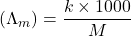
Define electrochemical cell. What happens if external potential applied becomes greater than  of electrochemical cell ?
An electrochemical cell is a device in which chemical energy of the redox reaction is converted into electrical energy. While electrolytic cell do the reverse.
→ e– flow from Cu to Zn and current flows from Zn to Cu.