
IMPORTANT FORMULAE of SOLUTIONS

In the formulae given below A represents solvent and B represents solute, also
MA = Molar mass of solvent MB = Molar mass of solute
WA = Mass of solvent VB = volume of solute
V = Volume of solution d = density of solution.
1(a). Mass of percentage (w/w) = 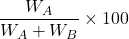
(b). Volume percentage (v/v) = 
(c). Mass by volume percentage (W/v) = 
(d). Parts per million (ppm) = 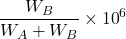
2. Mole fraction of A, XA = 
mole fraction of B, XB = 
XA + XB = 1
3. Molarity (M) =  =
=  =
= 
4. Molality (m) = 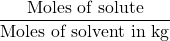 =
=  =
= 
5. Normality (N) =  =
= 
6. Relationship between Molarity and Normality
The normality (N) and molarity (M) of a solution are related as follows :
Normality × Equivalent. mass (solute) = Molarity × Molar mass (solute)
7. Relationship between Molarity and Mass percentage (p)
If p is the mass percentage and d is the density of the solution then
Molarity = 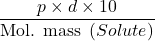
Normality = 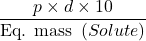
8. Dilution formula: If the solution of some substance is diluted by adding solvent from volume V1 to volume V2, then
M1V1 = M2V2 Similarly, N1V1 = N2V2
9. Raoult’s law for volatile solute
pA = pA0 xA and pB0 xB
where pA and pB are partial vapour pressures of component ‘A’ and component ‘B’ in the solution.
PA0 and pB0 are vapour pressures of pure components ‘A’ and ‘B’ respectively.
Total vapour pressure = p = pA + pB = pA0 xA + pB0 xB
10. Raoult’s law for non-volatile solute
 = XB = (For a dilute solution nB << nA)
11. Elevation in boiling point.
∆Tb = Kb × m
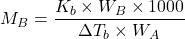
where, 
12. Depression in freezing point.
∆Tf = Kf × m
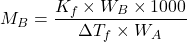
where, 
13. Osmotic pressure (π).
π = cRT where ‘c’ is molarity.
Leave a Reply