
EXERCISE 1.2

Question 1:
Show that the function  defined by
  is one –one and onto, where
  is the set of all non –zero real numbers. Is the result true, if the domain is replaced by N with codomain being same as ?
Solution:
is by 
For one-one:
 such that
⇒ 
⇒ x = y
f is one-one.
For onto:
For  , there exists
 ![\displaystyle x=\frac{1}{y}\in {{R}_{0}}\left[ {\text{as }y\in 0} \right]](https://gyanpoints.com/wp-content/ql-cache/quicklatex.com-d582ccbcc023b5927cccbff8ab785af0_l3.png "Rendered by QuickLaTeX.com") such that
such that 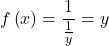
f is onto.
Given function f is one-one and onto.
Consider function  defined by

⇒ 
⇒ 
We have g is one-one
G is not onto as for  there exist any x in N such that
  function is one-one but not onto.
Question 2:
Check the injectivity and surjectivity of the following functions:
(i)  given by
(ii)  given by
(iii) given by 
(iv) given by
Solution:
(i) For given by
x, y∈ N
f(x) = f(y) ⇒ x2 = y2 ⇒ x = y
∴ f is injective.
2∈N. But, there does not exist any x in N such that f(x) = x2 = 2
∴ f is not surjective
Function f is injective but not surjective.
(ii) f:Z→Z given by f(x) = x2
F(-1) = f(1) = 1 but -1 ≠ 1
∴ f is not injective.
-2 ∈ Z But, there does not exist any x ∈ Z such that f(x) = -2 ⇒ x2 = -2
∴ f is not surjective.
Function f is neither injective nor surjective.
(iii) given by
 but – 1 ≠ 1
∴ f is not injective.
-2 ∈ Z But, there does not exist any x ∈ Z such that f(x) = – 2 ⇒ x2 = -2
∴ f is not surjective
Function f is neither injective nor surjective.
(iv) given by
x, y ∈ N
f(x) = f(y) = x3 = y3 ⇒ x = y
∴ f is injective.
2 ∈ Z But, there does not exist any x ∈ Z such that f(x) = x3 = 2
∴ f is not surjective
Function f is neither injective nor surjective.
(iv) given by
x, y ∈ N
f(x) = f(y) = x3 = y3 ⇒ x = y
∴ f is injective.
2 ∈ Z But, there does not exist any x ∈ Z such that f(x) = x3 = 2
∴ f is not surjective
Function f is neither injective nor surjective.
Question 3:
Prove that the greatest integer function f:R→R given by ![\displaystyle f\left( x \right)=\left[ x \right]](https://gyanpoints.com/wp-content/ql-cache/quicklatex.com-7c04751f3a23e1b9bf712486394f4583_l3.png "Rendered by QuickLaTeX.com") is neither one-one nor onto, where
is neither one-one nor onto, where ![\displaystyle \left[ x \right]](https://gyanpoints.com/wp-content/ql-cache/quicklatex.com-393bd8bb953c8dd15435cf364e9d9c0e_l3.png "Rendered by QuickLaTeX.com") denotes the greatest integer less than or equal to x.
denotes the greatest integer less than or equal to x.
Solution:
 given by
![\displaystyle f\left( {1.2} \right)=\left[ {1.2} \right]=1,f\left( {1.9} \right)=\left[ {1.9} \right]=1](https://gyanpoints.com/wp-content/ql-cache/quicklatex.com-fe554aa51f6bdee2b1ffa804e1647280_l3.png "Rendered by QuickLaTeX.com")
 but 1.2 ≠ 1.9
∴ f is not one-one
Consider 0.7 ∈ R
f(x) = [x] is an integer. There does not exist any element x ∈R such that f(x) = 0.7
∴ f is not onto.
The greatest integer function is neither one-one nor onto.
Question 4:
Show that the modulus function f:R→R given by f(x) = ∣x∣ is neither one-one nor onto,
where ∣x∣ is x, if x is positive or and ∣x∣ is – x , if x is negative
Solution:
f: R→R is f(x) = ∣x∣ = 
f(-1) = ∣-1∣ = 1 and f(1) = ∣1∣ = 1
f(-1) = f(1) but -1≠ 1
∴ f is not one-one.
Consider -1 ∈ R
f(x):∣x∣ is non-negative. There exist any element x in domain R such that f(x):∣x∣ = -1
∴ f is not onto.
The modulus function is neither one-one nor onto.
Question 5:
Show that the signum function f: R→R given by 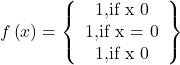 is neither one-one nor onto.
Solution:
f: R→R is
f(1) = f(2) =1 but 1≠2
∴ f is not one-one.
f(x) takes only 3 values (1,0,1) for the element -2 in co-domain R, there does not exist any x in domain R such that f (x) = – 2.
∴ f is not onto.
The signum function is neither one-one nor onto.
Question 6:
Let A = {1,2,3}, B = {4,5,6,7}and let f = {(1,4),(2,5),(3,6)} be a function from A to B. Show that f is one-one.
Solution:
A = (1,2,3), B = {4,5,6,7}
f: A→B is defined as f = {(1,4),(2,5),(3,6)}
∴ f(1) = 4, f(2) = 5, f(3) = 6
It is seen that the images of distinct element of A under f are distinct.
∴ f is not one-one.
Question 7:
In each of the following cases, state whether the function is one-one, onto or bijective. Justify your answer.
i. f:R→R defined by f(x) = 3 – 4x
ii. f:R→R defined by f(x) = 1 + x2
Solution:
(i) f:R→R defined by f(x) = 3 – 4x
x1, x2 ∈ R such that f(x1) = f(x2)
⇒ 3 – 4×1 = 3 – 4×2
⇒ – 4×1 = – 4×2
⇒ x1 = x2
∴ f is not one-one.
For any real number (y) in R, there exists  in R such that
∴ f is onto.
Hence, f is bijective.
ii. f:R→R defined by f(x) = 1 + x2
x1, x2 ∈ R such that f(x1) = f(x2)
⇒ 
⇒ 
⇒ 
 does not imply that x1 = x2.
Consider f(1) = f(-1) = 2
∴ f is not one-one.
Consider an element – 2 in co domain R.
It is seen that  is positive for all .
∴ f is not onto.
Hence, f is neither one-one nor onto.
Question 8:
Let A and B be sets. Show that  such that (a,b) = (b,a) is a bijective function.
Solution:
is defined as (a,b) = (b,a).
 such that

⇒ b1 = b2 and a1 = a2
⇒ (a1, b1) = (a2, b2)
∴ f is one-one.
(b, a) ∈ B × A there exist (a, b) ∈ A × B such that f(a, b) = (b, a)
∴ f is onto.
f is bijective.
Question 9:
Let f:N→N be defined as  for all n∈N. State whether the function is bijective. Justify your answer.
Solution:
f:N→N be defined as for all n∈N.
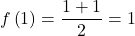 and
and 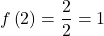
f(1) = f(2), where 1 ≠ 2
∴ f is not one-one.
Consider a natural number n in co domain N.
Case 1. n is odd
∴ n = 2r + 1 for some r ∈ N there exists 4r + 1 ∈ N such that

there exists 4r ∈ N such that
is not a bijective function.
Case 2. n is even
∴ n = 2r for some r ∈ N there exists 4r ∈ N such that
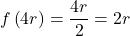
∴ f is onto.
∴ f is not a bijective function.
Question 10:
Let A = R – {3}, B = R – {1} and f:A→B defined by  . Is f one-one and onto?
Justify your answer.
Solution:
A = R – {3}, B = R – {1} and f:A→B defined by .
x, y ∈ A such that f(x) = f(y)
⇒ 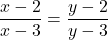
⇒ (x-2)(y-3) = (y-2)(x-3)
⇒ xy – 3x – 2y + 6 = xy – 3y – 2x + 6
⇒ -3x – 2y = 3y – 2x
⇒ 3x – 2x = 3y – 2y
⇒ x = y
∴ f is one-one.
Leave a Reply